By Thuc Nhi Nguyen
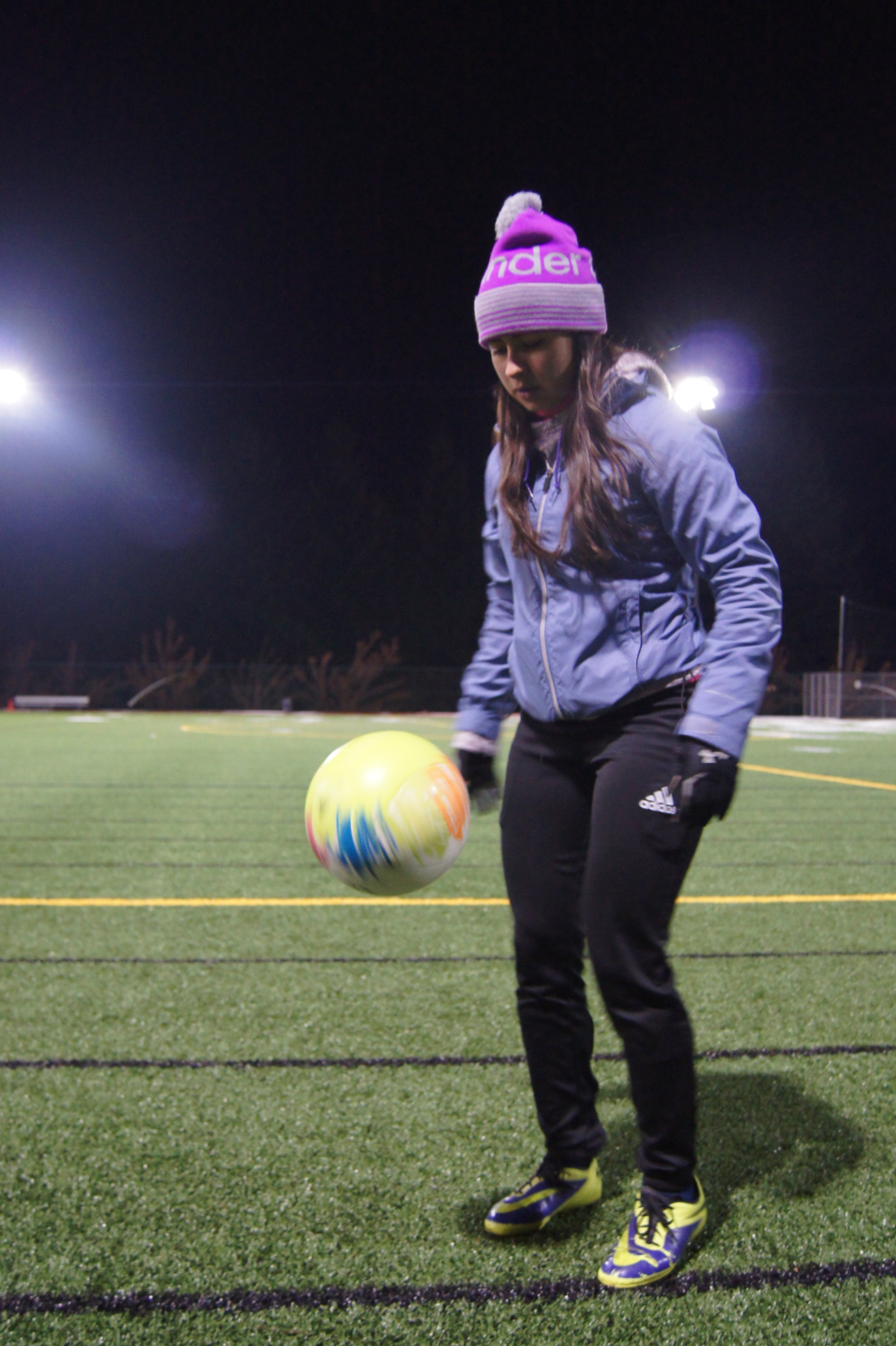
Sandwiched in between two sets of brothers, Veronica Gonzalez grew up in Yelm, Wash., surrounded by soccer.
She loved to play with her brothers, two older and two younger. She watched them test their tactical skills, practiced her own, and reveled in her brothers’ passion for the beautiful game.
Her mother did not share that same passion.
Gonzalez, born to Mexican immigrants who came to the United States when she was 10, wasn’t supposed to be playing soccer, her mother told her. Girls didn’t play soccer.
Not so anymore.
The emergence of women’s soccer leagues in many Hispanic soccer leagues including Liga Azteca, which is based out of Kent, Wash., has given women from across the region the opportunity to participate in a competitive soccer league embracing a part of their culture that hadn’t always embraced them back.
“In México, it’s always that machismo thing: guys are supposed to do this and girls are supposed to say home, and be stay-at-home moms and watch the kids, cook, clean,” said Gonzalez, who eventually won her mother over with the support of her father and brothers. “They can’t do any sports because it didn’t look right.”
Women were strongly discouraged from playing the sport in many Latin American countries and were even banned from playing in Brazil — the most prominent soccer country in the world — for almost four decades from 1941 to 1979 by the National Sports Council .
However, interest in women’s soccer has grown recently. After the conclusion of the previous Women’s World Cup, KantarSport , a sports and entertainment research company, produced a television audience report for the 2011 FIFA Women’s World Cup television numbers. The report found that more people watched the 2011 Women’s World Cup, which was hosted in Germany, than the 2007 edition hosted in China, and did so for longer periods of time.
In 2007, FIFA, the governing body of international soccer, released the results of a survey that found that the number of women playing soccer worldwide increased by more than 18 percent from 2000 to 2006, from 22 million to 26 million.
Of the world’s female soccer players, 23 percent came from the CONCACAF region that includes North America, Central America and the Caribbean, with 11 percent coming from South America.
However, men still made up 90 percent of all players worldwide, the FIFA survey found.
Jessica Gallardo , a forward/midfielder for Liga Azteca’s Seasound FC , said that when she was growing in El Salvador, she rarely saw women playing soccer. Playing in the streets with friends and neighbors, with just a ball and rocks marking the goal, she had aspirations of playing professionally.
But El Salvador has no professional women’s team, and the country’s women’s national team has never qualified CONCACAF Women’s Gold Cup , which is the qualifying tournament for the World Cup, let alone for the World Cup itself.
She continued to play because she loved it, even though she was often the only female playing.
“As I was getting older, people weren’t very supportive of my playing soccer with the guys because they said it was more of a men’s sport,” said Gallardo, who is one of Liga Azteca’s leading scorers this season. “Women like soccer too, but it was more for them to just watch, but not to really play it.”
Liga Azteca, which has swollen from 12 teams to 40 teams in the past five years, has leagues for men, women, co-ed, and youth. The women’s league started three years ago, with the youth league coming one year after that.
Jose Gomez , a league coordinator, looks at the addition of the children’s league as one of his proudest accomplishments.
Working with young girls and boys who come from soccer-crazed families just like the one he grew up in and then seeing the smiles spread across the faces of the children as they receive their medals and trophies at the end of the season is the best part of his very busy job, he said.
In Liga Azteca, the girls in the youth leagues generally play with the boys, but have their own under-8 league as well. The recent surge in girls’ leagues has Gomez especially optimistic for the future of Liga Azteca.
“Normally, Hispanic people, women don’t play soccer,” Gomez said. “Now a lot of Hispanic girls play soccer and before three years ago, no Latin girls played soccer. … That’s a big thing for people to come to this country and their girls can play soccer.”
Gomez said the league’s expansion is due mainly to its behind-the-scenes organization that keeps athletes and coaches in touch through Facebook and website announcements. The league keeps official statistics for the leading scorers, updating the standings weekly after each weekend’s set of games.
Currently, Liga Azteca has eight women’s teams, each with at least 18 players. In one season, the league has had up to 16 teams.
“They’re encouraging more girls to play and giving them a place to play,” said Gonzalez, a forward/midfielder on Galacticas who is often near the top of the league’s scoring charts. “They’re doing it how it should be.”
Since joining the Liga Azteca staff in 2012, Edwin Montufar has been a driving force being the organization of the women’s league. He updates statistics and schedules each week, just like the men’s league has.
“I’m comfortable saying that we have the best women’s league in local soccer for the Latino community,” Montufar said.
Montufar’s 6-year-old daughter often went with her parents to watch their soccer matches, and soon asked when she could play on a team of her own. Although their daughter was too young at the time to play in Liga Azteca, Montufar and his wife Mayra, who has been playing in Liga Azteca’s women’s league for four years, found a program for their daughter to fuel a growing passion for the sport that has gained popularity in the United States, especially with the U.S. Women’s National Team being a favorite to claim next year’s FIFA Women’s World Cup crown.
“Parents see the U.S. women’s team and they know that at least here, they have the support and it’s easier to find the resources to support and motivate them to get into a sport,” Mayra said.
When Gonzalez was growing up, she loved watching Mia Hamm , who helped the U.S. Women’s National Team to two World Cup titles. Hamm was an American hero, an international soccer star who became the country’s icon for women’s athletics in the 1990s along with fellow 1999 World Cup champions Brandi Chastain and Michelle Akers.
“To me, she was the coolest thing ever,” Gonzalez said of Hamm. “I saw her as a role model. … [I thought] someday I want to be like them. Someday I want to be a Mia Hamm.”
With the expansion on women’s soccer leagues, more girls can get their chances to do just that.