
By Elizabeth Alvarado
Nowadays, it’s typical to hear the word “undocumented” being thrown around constantly in the media.
Especially with the upcoming presidential election, undocumented immigrants are a hot topic. But for some, it can be difficult to fully grasp what it means to be undocumented.
An undocumented student is an immigrant who entered the United States without official inspection or overstayed their visa and is present in the United States with or without their parents. As a result, they face many legal uncertainties and have limitations on what they can and can’t do in our society and in the education system.
In order to help combat these issues, the University of Washington unveiled the Leadership Without Borders center on campus in 2014, which aims to create a space and community where undocumented students can come together. It’s also the first center of its kind in the Pacific Northwest.
The center offers support and resources to students such as referral services to get legal help, a textbook lending library and a sense of community where they feel like they belong.
For one of the founders of the center, Magdalena Fonseca, this is an issue she feels strongly about, having been undocumented in the past.
“I’m originally from Mexico. My family immigrated here when I was 6 years old. I was undocumented. The way we lived was very tough on me and my family,” said Fonseca. “A lot of it is what our students are experiencing right now: feeling like you’re isolated, feeling like you’re always being hunted and having to protect ourselves from being found out.”
Currently there are 85 self-identified undocumented students on campus, with an estimated 150-300 undocumented students attending the University of Washington, said Gabriel Gallardo, Interim Vice President for Minority Affairs and Interim Vice Provost for Diversity last November in an interview with the University of Washington’s Office of the Provost.
According to the Ethnic Cultural Center, the first undocumented students who were open about their status appeared in 2002, around the time that The Development, Relief and Education of Alien Minors Act, also called the DREAM Act was first introduced in the U.S. Congress. It’s difficult to pinpoint an exact number because of the Family Education Privacy Act which protects students’ legal status.
Fonseca received papers, meaning she became a legal citizen, when she was 17 and after graduating from college she took a job at the University of Washington’s Ethnic Cultural Center which made her want to do more for the community of undocumented students.
“One of the things I started to notice from working with a bunch of students from different backgrounds and experiences was that there were students here that were undocumented and immediately, I felt this connection,” said Fonseca.
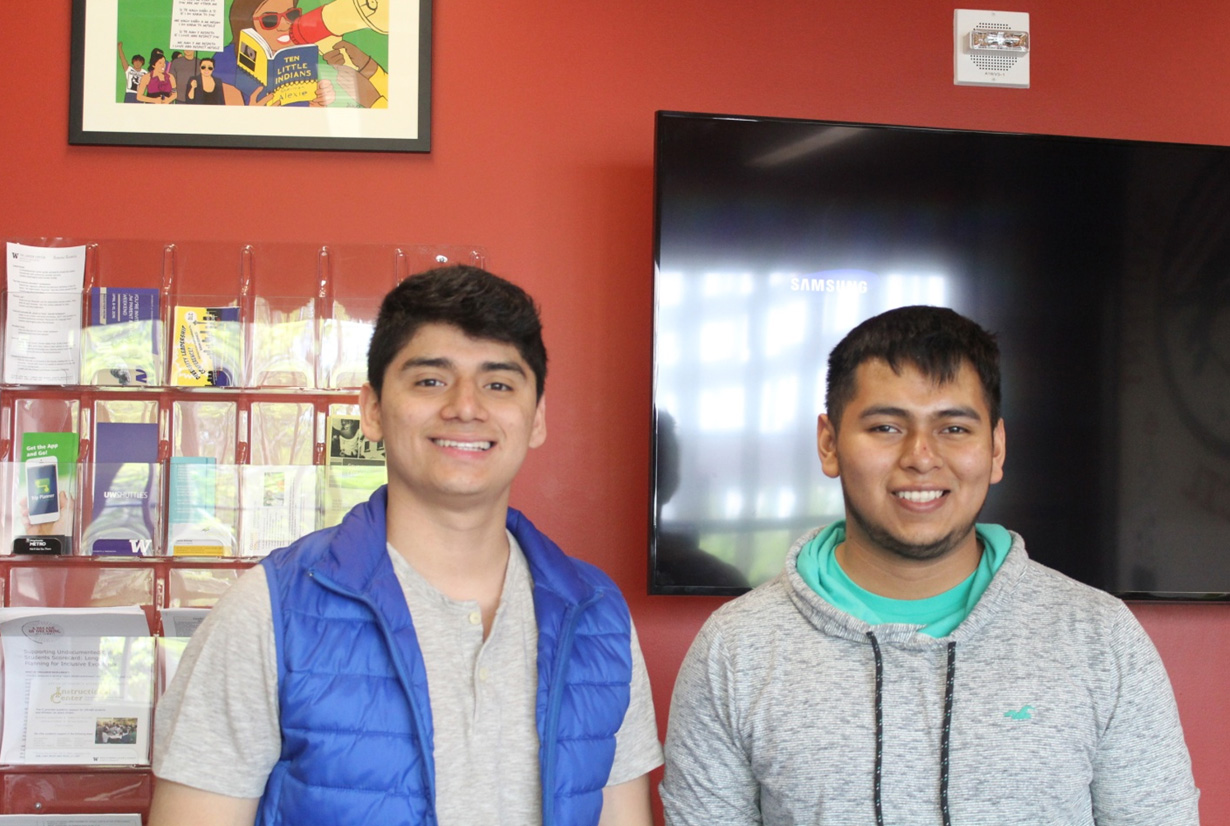
At the time, a center for undocumented students didn’t exist but through word of mouth, students reached out to her for help. This was one of the factors that led Fonseca to start the center. Current intern Agustin Garcia says the center has helped him immensely as a student.
“My favorite part of Leadership Without Borders would be the community of undocumented students that is built off of it,” said Garcia. “When I was in high school I really didn’t have that, so I think that here in college, it’s had a big impact on me.”
Similarly, first-year student Luis Alejo says LWB has made him feel less alone in his struggles of being undocumented.
“The hardest struggle would be getting scholarships and being able to support ourselves in college. Some students have to work two jobs. That’s really tough, but I think UW is getting better with the resources they provide,” said Alejo.
While Leadership Without Borders is a great start for supporting undocumented students, Fonseca also acknowledges the progress Washington state has also made in terms of helping undocumented students.
She cites the 2003 Washington State Legislature approved HB (House Bill) 1079 which allows students to pay in-state tuition rates and 2014’s REAL Hope Act (SB6523) which expanded the eligibility for the Washington State Need Grant to non-citizens who meet the program’s requirements.
“I have to give kudos to Washington state with this topic. But it would be great if in the end the bigger government would provide a pathway for students who do come to college to get citizenship,” said Fonseca. “And I know that’s what the DREAM act is set to do but it keeps getting knocked down and that is the one thing that I would love to see.”
As Fonseca looks to the future of Leadership Without Borders she hopes to someday be able to expand the center into its own building since it’s currently housed in the Ethnic Cultural Center and to continue empowering undocumented students.
In the meantime, Garcia believes that everyone should take the time to visit Leadership Without Borders.
“For those who are not undocumented, I would say visit the space,” said Garcia. “Come learn about undocumented students, become familiar with our struggles and come learn who we are because we need more allies.”
Elizabeth Alvarado is a junior at the University of Washington majoring in journalism. Her work has been featured in The Seattle Globalist, The UW Daily, College Magazine, Fanciful Magazine and Drama in the Hood.