
SUE MANNING
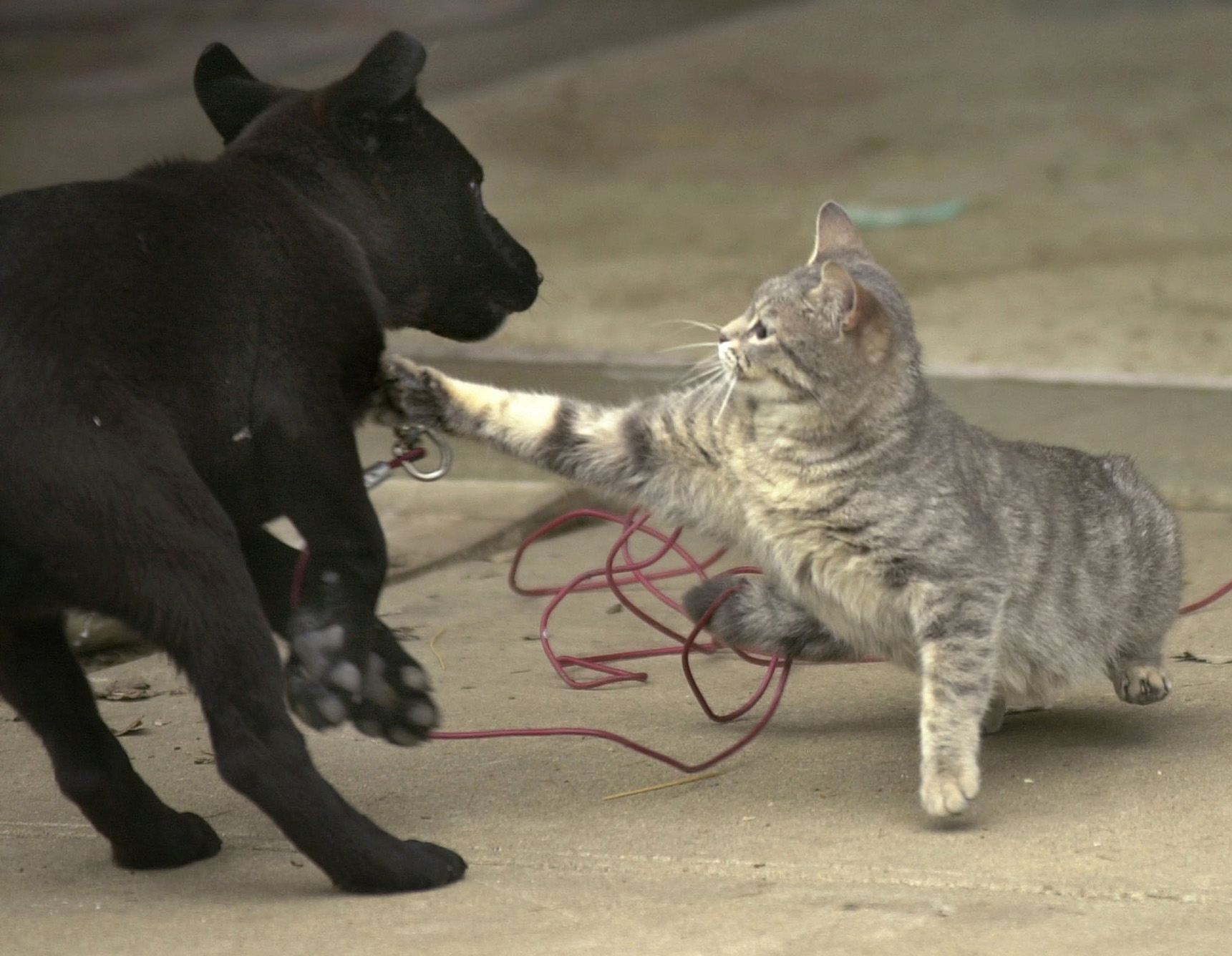
LOS ANGELES (AP) — Cats. Dogs. Those can be fighting words in some circles.
Clearly, there are dog people and there are cat people. But it’s not much of a contest: 74 percent of people like dogs a lot, and only 41 percent like cats a lot.
Cats win the dislike vote handily, according to an Associated Press-Petside.com poll. Fifteen percent of the adults questioned said they disliked cats a lot while the number who said they disliked dogs a lot was just 2 percent.
Joseph Moreus, 61, of Westminster, Calif., understands why dogs come out on top.
“They have more personality. They are loyal,” he said. “Cats are all about cats but dogs are interested in pleasing their owners. Cats don’t care if they please you or not.”
And cats can be destructive, said Joy Rasch, 70, of Kennewick, Wash., who gets mad at the neighborhood cats who kill robins, quail and squirrels in her back yard. Male cats will spray their territory or get in the wood pile at 3 a.m. and “screech like bad brakes on a car,” she added.
Of course, cat lovers, if smaller in numbers, are equal in passion.
“Cats are 1,000 times smarter than dogs,” said Bonnie Hanson, 77, of Sioux Falls, S.D. She and her late husband had a black Siamese cat, Kitty, that she said “always wanted to comfort people, anybody who was ill or unhappy.”
About 59 percent of American households own pets, according to the poll. About 74 percent of pet owners polled said they had dogs, and 47 percent said they had cats.
Those most likely to dislike cats were blacks, Hispanics and married men. Men were a bit more likely than women to say they disliked cats.
Still, all this sniping doesn’t mean there is no harmony in the country. Sixty percent of all adults said they liked both dogs AND cats.
And some, of course, don’t want either species for a friend.
“I have a fear of dogs and I don’t like cats,” said Willie Thigpen, 60, of Greenwood, S.C. “And now I don’t want to take care of nothing except me,” he said.
The AP-Petside.com poll was conducted Oct. 1-5, 2009, by GfK Roper Public Affairs & Media. It involved telephone interviews on landline and cell phones with 1,967 adults nationwide, including 1,166 pet owners and has a margin of sampling error of plus or minus 2.2 percentage points for all adults.
The margin of sampling error is higher and varies for results based on sub-samples.