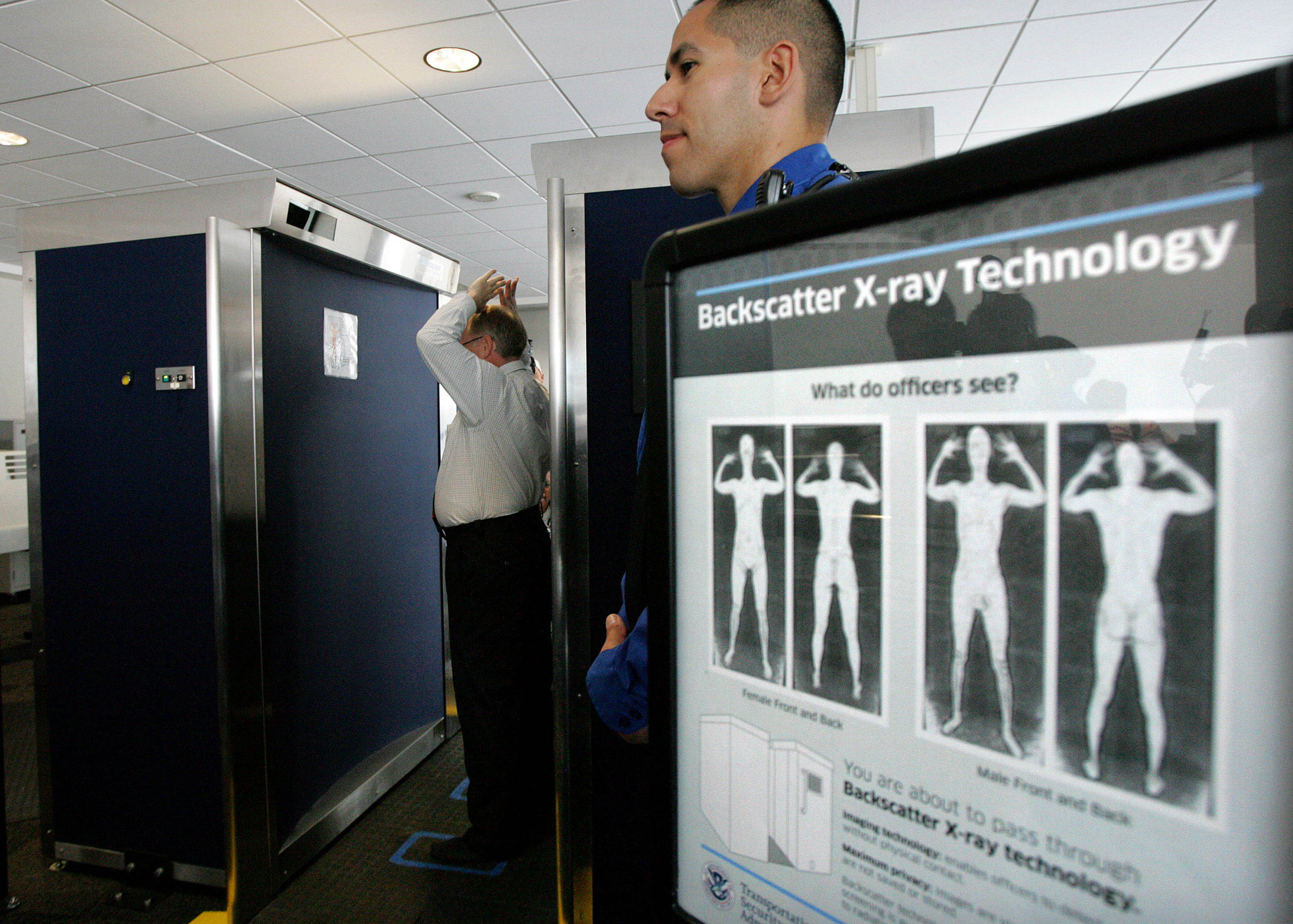
AP/Eduardo Contreras
(AP) — The process of heading home for the holidays will, for many travelers, contain some new hurdles this year. New measures aimed at thwarting potential terrorists may throw you off course if you’re unprepared.
Body Scanners
Some travelers and privacy advocates don’t like them, but body scanners are a growing presence in the nation’s airports. One model that uses X-rays has raised health worries. Security needs have trumped those concerns since last Christmas, when a man attempted to bring down an Amsterdam-to-Detroit flight by detonating explosives he’d hidden in his underwear.
The Transportation Security Administration, which oversees airport security, aims to have 450 of the machines installed by the end of the year, though it isn’t divulging locations for the new ones.
Here’s good news for the self- or health-conscious: You aren’t required to go through the machine. Any traveler can choose a pat-down instead. The pat-down is “at a level comparable to what the body scanner would provide,” says TSA spokesman Nick Kimball.
There are two types of scanners. One is a six-sided portal that requires a passenger to stand inside, hands over their head, while radio wave technology scans the body to produce a 3-D image.
The other model uses X-ray technology. It looks like two large boxes, side by side. The traveler walks in and pauses while the machine takes an image on a monitor. The TSA says the radiation is equivalent to what a passenger in exposed to in 2 minutes on an airplane.
Some airports have both types of machines; others have one or the other. Even if an airport has body scanners, they won’t always be at every checkpoint.
Secure Flight
Secure Flight is a behind-the-scenes effort by the TSA to better match potential terrorists with watch lists. The program, which has been rolled out in phases, will formally start on Nov. 1. It requires airlines to collect a passenger’s full name, birth date and gender at booking. Passengers that don’t provide that information at least 72 hours before a flight won’t be issued a boarding pass.
You could run into problems when you get to the airport if your name as listed on your government identification is different than on your ticket.
Some suggestions to ensure you’re not denied a boarding pass or held up at security:
— Check for misspellings on your ticket. Contact the airline if you find an error.
— Don’t use nicknames when booking. Using “Maggie” instead of “Margaret” might hold you up.
— If you recently got married or changed your name, book your flight under the same name that’s listed on your driver’s license or passport.
— Pay attention to detail: If your name is listed as “John C. Doe” on your ID, don’t fill out “John Christopher Doe” when you book. A discrepancy like that will probably be resolved, but even the smallest difference could lead a security agent at the airport to do a double-take, slowing you down.